
Learning to See, Listen, and Act Differently
I entered the program with professional experience in supporting people, leading teams, and developing organizational strategies. The MA has strengthened my ability to examine the assumptions behind that work, connect individual experiences with wider structures, and make ethical commitments concrete.
The following four outcomes show where that progress has been most meaningful. They connect my academic work with the leadership, research, and communication I now use in a daily basis.
Applying Interdisciplinary Knowledge
Program outcome: Articulate and apply advanced, interdisciplinary theories and practices of human rights and social justice, from legal, academic, and experiential perspectives.
My clinical background gave me experience attending to trauma, individual circumstances and group systems. Through the MA, I have developed a stronger ability to connect those experiences with legal protections, institutional practices, historical conditions, and unequal relations of power.
My paper on feminicide in Mexico brought feminist analysis into conversation with trauma, impunity, and human rights. My Rwanda research connected genocide studies with narrative, governance, and collective memory. Working across these fields helped me move beyond a single explanation of harm and consider how different frameworks reveal different dimensions of the same problem.
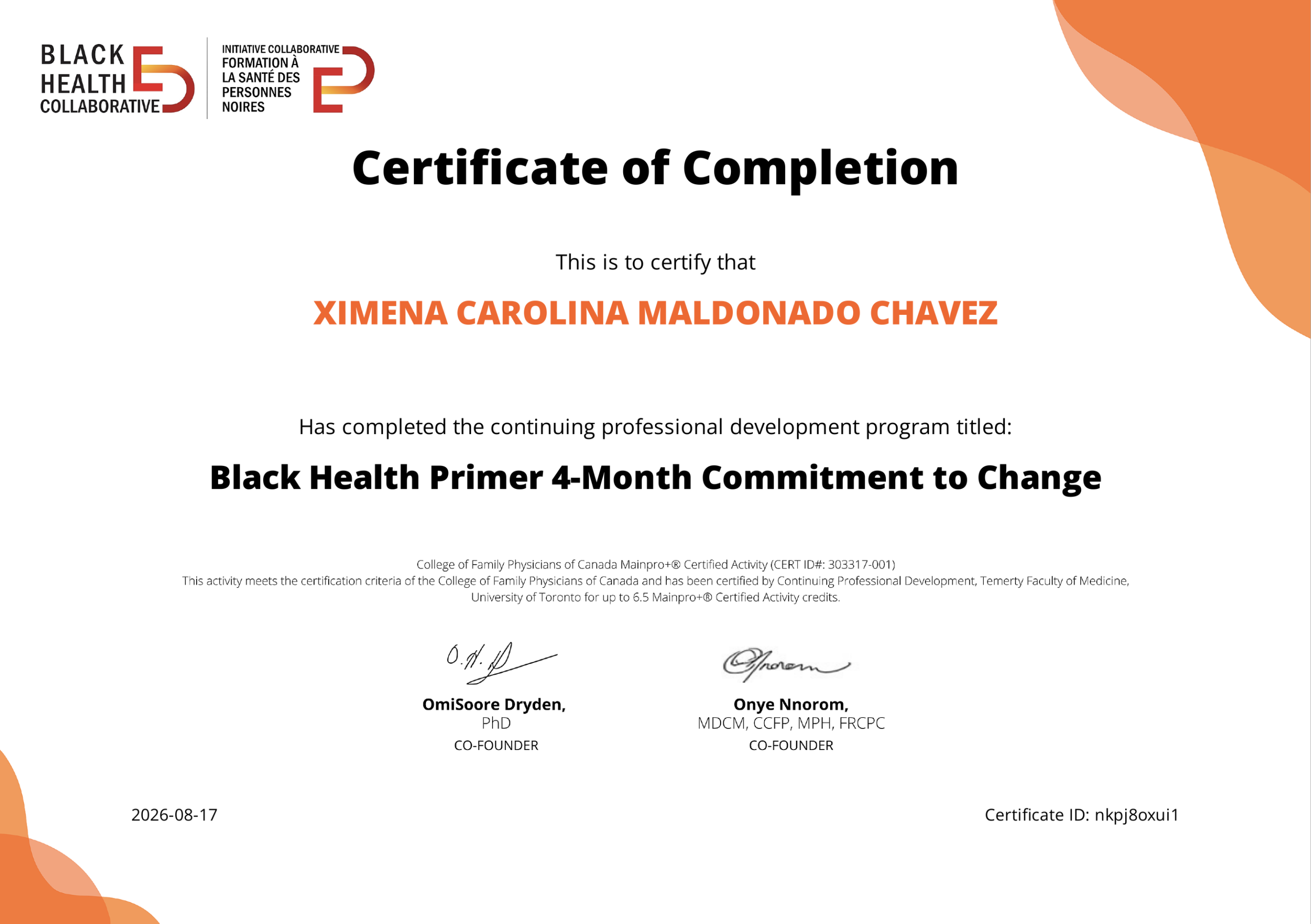
The Health for All course extended this approach to health equity. The Black Health Primer and my gender-affirming care infographic required me to connect social conditions, institutional decisions, and access to care, then communicate those connections in a way that was clear and simple.
My progress lies in how I now frame a problem. I consider the person’s experience alongside the systems shaping it, recognizing the intertwined relationships between everything and with decolonial approaches. This supports more thoughtful program planning: identifying barriers, drawing on different forms of expertise, and connecting immediate support with longer-term advocacy.
Examining How Research Produces Knowledge
Program outcome: Demonstrate advanced critical thinking in relation to established techniques and methods of research and inquiry that are used to create and interpret knowledge in the field of human rights and social justice.
The program has strengthened my attention to the authority involved in research. Choosing a question, selecting sources, and interpreting an experience all influence what can become visible and whose perspective carries weight.
I’ve examined narratives and memory through existing scholarship and documentary materials. I was really interested on knowing how sources frame events and how public accounts of violence shape recognition. This helped me become more deliberate about the limits of my own interpretation.
My grant proposal on intimate partner violence among 2SLGBTQIA+ survivors developed this learning further. I designed a participatory action research (PAR) approach in which survivors and community stakeholders would contribute to generating knowledge, interpreting themes, and developing recommendations.
I also planned trauma-informed safeguards, mental health support, participant compensation, and guidance from a Two-Spirit knowledge keeper. These are proposed arrangements, rather than completed research activities.
My progress is visible in the connection between methodology and responsibility. I am better able to explain why a method fits a question, whose participation it enables, and what resources are needed to make that participation respectful. This is relevant to nonprofit research, needs assessments, evaluation, and grant development.
Respecting Indigenous Knowledge and Wisdom
Program outcome: Demonstrate a sophisticated understanding of and respect for the values of a range of Indigenous knowledge and wisdom.
Indigenous Ways of Knowing challenged assumptions I had carried about where knowledge resides and how it should be communicated. When I reeded my journal I cans see a growing attention to relationships, land, oral traditions, reciprocity, and my position as a newcomer.
I am learning to approach Indigenous teachings with greater care for their specific contexts and the authority of the people who share them. Connections with my experiences in Mexico can open questions, but they do not make different histories or knowledge traditions interchangeable.
In Trusting the Untrustworthy, I wrote about how Two-Spirit resurgence challenges institutional approaches to inclusion. The paper helped me distinguish recognition within an institution from questions about land, sovereignty, and community. It also reaffirmed my awareness that Two-Spirit experiences cannot simply be absorbed into a general LGBTQ+ framework.
This learning influenced the design of my research proposal. I included a proposed knowledge keeper role to guide engagement and interpretation, with compensation for that contribution. The process helped me consider how respect must affect the organization of a project, including who makes decisions and how expertise is recognized.
I view this outcome as an ongoing responsibility. Progress involves greater specificity, humility, and accountability, as well as recognizing the limits of what I know.
Leading Across Different Perspectives
Program outcome: Demonstrate leadership in recognizing, respecting, and advancing the value of intercultural understanding and worldviews regarding human and environmental diversity.
The MA has deepened an existing leadership background by asking me to examine whose participation my decisions enable. I have become more deliberate about communication, accessibility, and the relationship between organizational authority and accountability.
My practicum presentation showed me to translate complex issues affecting 2SLGBTQIA+ newcomers into material relevant and friendly to service professionals. Designing and developing training and practical resources showed me to connect theory with everyday decisions and facilitate discussion across different levels of understanding.
My TRUSU responsibilities give me the opportunity to transform classroom learning into advocacy, including outreach and budget decisions. Giving the Pride speech challenged me into public speaking and emotional vulnerability: connecting my personal story with so many people and at the same time inviting them into solidarity while respecting different identities and experiences showed me how theory can connect deeply in practice.
My roles as a TA, RA, and Research Coach also require communication across different perspectives. They encourage me to clarify ideas, listen to questions, and recognize that unfamiliarity with academic language does not indicate a lack of insight.
Indigenous and relational learning expand all the time my attention to responsibilities toward land and more-than-human life without omitting systems of oppression. Also, my community engagement work strengthens my ability to coordinate conversations between people and institutions.
I now understand leadership more fully as the work of listening, creating conditions for participation, allocating resources thoughtfully, and following through on commitments.